
A Serious Report for Adversaries; Shrugs for Partners and Allies
Why Congress Needs a Will-to-Fight Assessment for U.S. Partners

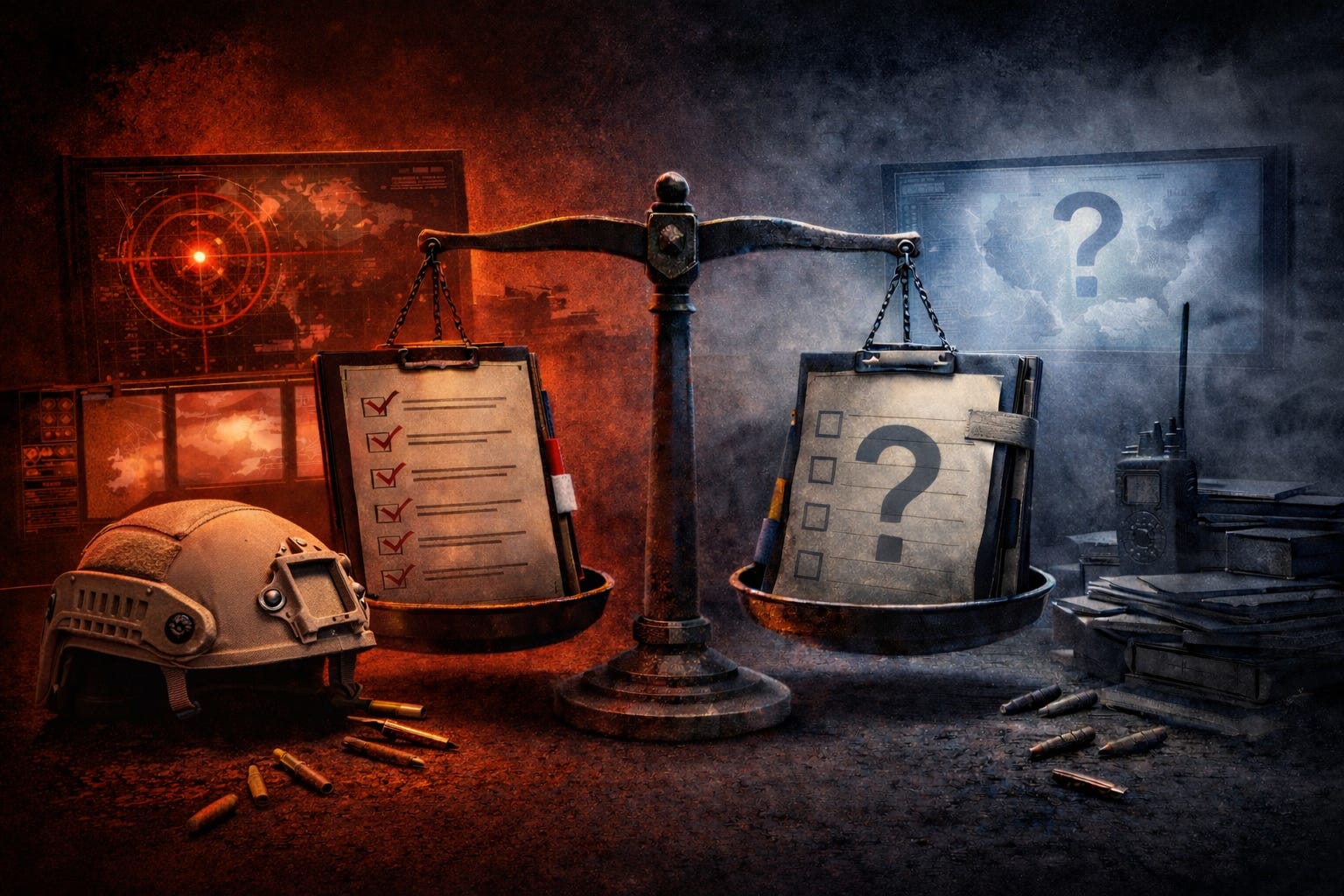
Why do American taxpayers know more about our adversaries’ capacity to fight and win wars than our allies’?
Every year, the Pentagon delivers a detailed public report to Congress on China’s military and security posture, pages of analysis on force structure, doctrine, and trajectory, all focused on the overarching question: “What is China doing to prepare for a fight, and if they do get into one, how will they do it?”
Yet for countries the United States arms, trains, and expects to fight alongside us in a possible future conflict with China or Russia, the question “Will they actually fight?” is still too often left to guesswork.
Congress has the power to ensure and must ensure the next National Defense Authorization Act directs the Department of Defense to research, draft, and produce an annual assessment of our partners’ whole-of-society security, or commonly called “will-to-fight,” accounting for each country’s disposition and capacity to resist violence from another state in conflict.
How Do We Know If They Are Doing Their Part?
American failures in Afghanistan, the Sahel, and Iraq were not a series of flukes; they were a flashing red light on major deficiencies in the U.S. military’s capacity to understand, engage, and ensure our partners can do the most important task we ask of them. Despite a belated reckoning after those collapses and an increasing demand that partners do “their part on defense,” the United States still lacks a systematic way to assess whether they can actually do that and to publicly communicate whether partners will endure and persevere under violence or invasion from another state.
For decades, Congress has required the Department of Defense to produce a rigorous annual assessment of the People’s Republic of China’s economy, society, politics, and military forces. It is essentially a yearly check-in on China’s capacity to fight and win. There is no parallel mandate for partners such as Ukraine, Taiwan, the Philippines, Poland, and the Baltic states, despite the tremendous level of U.S. funding and equipment going to these nations.
Security Is More Than Soldiers: Answering Seven Questions That Matter
In the last several years, Congress has rightly pushed the Department of Defense to expand its understanding and assessment of the combat forces of partner nations’ will to fight. Still, those efforts stop short of a whole-of-society security approach.
There’s a better way. Based on my hands-on experience and research on U.S. security sector assistance in Africa, Europe, and Asia, interviews with practitioners and scholars, and lessons from two decades of failure and a few successes, these are seven strategic questions that consistently separate countries that hold from those that fold:
What is the political will of the government and major political parties to resist aggression?
What is the will of the armed forces and law enforcement agencies?
How resistant are the country’s security institutions to corruption and to elite or foreign capture?
Together, these seven questions form the foundation of a whole-of-society security assessment that is closer to true civil-military preparedness than counting tanks, missiles, or widgets. They ask whether leaders will mobilize across parties; whether citizens will accept rationing, blackouts, mobilization, and casualties; whether the armed forces, territorial defense, police, and interior ministry can fight jointly; whether the grid, ports, pipelines, and networks can keep energy, food, and data moving; whether hospitals, medevac, and mortuary affairs can absorb losses; whether industry and the private sector can repair, replace, and surge to meet the needs of the people. It also gauges information and cyber resilience, as well as the ability to govern under attack or threat of attack.
Done annually, this would ensure U.S. support is directed at what is critical as a country attempts to resist an invasion, rather than the narrow, staged optics of assessments that remain overwhelmingly military-focused.
Congress should require the DoD to answer these questions and others each year for priority partners, in two forms. The classified report would support informing resourcing, posture, plans, and cooperation—what or whether to fund, where to base, and who gets which kit. The unclassified report gives taxpayers and allies a candid baseline: where things stand, what is improving, and what still needs work.
Modeled on the seriousness and in-depth approach of the China report, these two forms of assessments would be a new avenue of research that would fill a critical gap in the information needed by Congress, the broader U.S. interagency, and the public on what our partners can actually accomplish, where they need support, and if the U.S. is adequately supporting them.
Military-Only Assessments Miss the Real Fight
The world is firmly in an era of hybrid threats, in which America and its allies and partners face threats from that crosscut security forces, industry, and culture, with no single element able to respond to them. In the event of large-scale combat operations in Europe or Asia, American soldiers are highly likely to be supporting and fighting alongside military personnel, police, border guards, irregular forces, private-sector actors, and others in critical industries. As Russia’s war on Ukraine has demonstrated and Ukraine’s actions to preserve its freedom, Total War has returned, and whole-of-society security has come along with it in response. Yet our security cooperation assessment models are still heavily rooted in a 1990s era of stability operations, peacekeeping, and counterterrorism.
If the American People Are Paying the Bill, They Are Owed an Honest Assessment
This isn’t a panacea for poor political decision-making towards arming and equipping partners and allies, but increased transparency will force discipline in how partners are assessed and supported if everyone is seeing the same information. It could also deter adversaries by signaling that our partner’s weak points are being addressed, not papered over. It would also serve as a corrective to one of the U.S. military’s worst habits: mistaking money and training hours for a partner’s resolve in a fight.
After two long wars and many failed counterterrorism “partner capacity” initiatives, Americans are growing more fatigued about supporting our partners and allies. If the government is going to spend taxpayers’ money and possibly ask them risk their lives in response to threats to our partners and allies, it owes them the truth about who they believe will actually fight when necessary. Congress already demands an honest assessment about our most capable adversary and the pacing challenge of our time; it is time to demand it of our friends.